
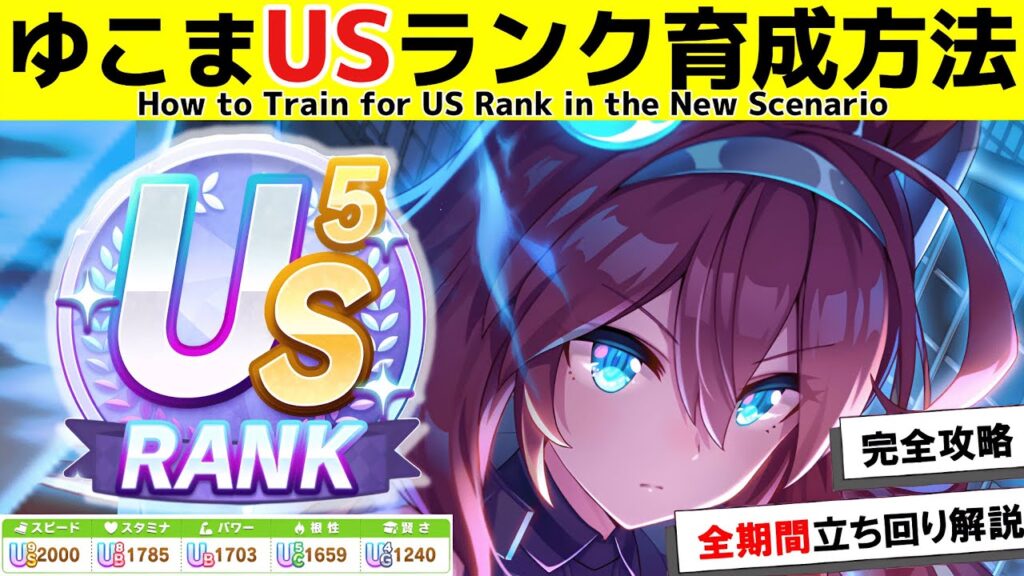
ゆこま温泉郷でUS~UAランクを育成するための知識・サポカ編成・源泉掘削・立ち回り方などをこの動画1本で詳しく解説【ウマ娘】【新シナリオ】【Umamusume:Pretty Derby】
This time, I’ll be explaining how to play the Yukoma Onsen scenario. Unlike the Deserted Island scenario, this one has more complex scenario mechanics and a greater element of luck. To create high-rank Uma Musume such as UA to US rank, you now need more strategic thinking, making the process more challenging. In this video, I’ll mainly focus on explaining how to manage your runs, including key knowledge and strategies. There are also certain ways to skillfully mitigate some of the luck elements, so I’ll be covering those points as well. I’ve also included some important notes for watching this video, so please make sure to read through them. First, I’ll start by explaining the support card setup. To begin with, as a prerequisite, the Yukoma Onsen scenario requires the friend-type support card Hoshina Kiyoko. If you don’t have this support card, please borrow it from a friend. Now, regarding the support card setup: basically, the support lineup uses a “Highlander” composition, with one Speed support card and one Wisdom support card. The most recommended setup is a five-type composition that leaves out Wit. Other options such as a five-type setup without Stamina, or a four-Guts setup, can also reach UA rank even without gacha SSR support cards, so I recommend them as well. Of course, there are many other possible support card setups, but there is one exception: a two-Wit setup is absolutely unacceptable for a certain reason, so please be careful. Next, when it comes to inheritance factors, I’d normally say to put everything into Speed as usual, but in the Yukoma Onsen scenario, due to the Speed cap and the effects of the scenario mechanics… In addition to the full-Speed setup, the two patterns above that reduce the amount of Speed factors also work perfectly fine. However, make sure that the total number of Speed stars is at least 12. Next, I’ll explain the order of hot spring source excavation, which is the most important—and also the most difficult—part of the Onsen scenario. The excavation rotation varies mainly depending on the育成ウマ娘’s goal races and your support card setup, so please use the YES/NO chart I’m about to show to find the pattern that fits your Umamusume. Start from the yellow box and follow the choices until you reach one of the numbered endpoints. Also, as a note when looking at the rotation patterns: the left four are fixed hot springs, so make sure to select them at the same points indicated in the rotation pattern. The right five are selectable hot springs, so choose them based on your Umamusume’s growth rates and current stats. Now, let’s take a look at the first excavation rotation pattern. Next, I’ll explain the mechanics and timing of your friend’s outings. First, during events where outings are possible, there are two choices, but basically, you should choose the lower option, which gives a skill hint. Choose the upper option when you don’t have a bath ticket or when you need to recover stamina to be able to train in the next turn. Next, the recommended timing for all five outings varies depending on the excavation rotation, so I’ll explain them in order. First, regarding rotation patterns ① to ⑩: as mentioned above, for the first to fourth outings, once per period is sufficient, but for the fifth outing, make sure to use it in the first half of September in the Senior phase. On the other hand, for rotation patterns ⑪ and ⑫, use the fourth outing by the latter half of December in the Classic phase, and the fifth outing by the latter half of February in the Senior phase. And make sure to use a bath ticket in the latter half of June. There is also one timing when you should never go on an outing, which is when you can perform a super recovery. At this time, do not go on an outing. Instead, use a bath ticket to trigger a super recovery, or if you don’t have a bath ticket, perform PR activities or hot spring excavation to obtain one, and then activate the super recovery. Also, the timing for triggering super recovery is somewhat predetermined, so next I’ll explain how the super recovery mechanic works. The super recovery that occasionally appears during training provides very powerful effects, such as increased stamina recovery and +100 skill points, so how many times it can be triggered in a single training run is crucial. And this super recovery doesn’t occur randomly; it happens according to a certain pattern. The pattern is that the probability of triggering it changes based on the total stamina consumed. Super recovery is triggered when the total stamina consumed exceeds any of the following: 50, 100, 150, 200, 250, or 300. The chance of triggering it likely increases with higher total stamina consumed, and if it exceeds 300, super recovery is guaranteed to occur in that turn. Therefore, if your current total stamina consumed is 280, going on an outing would waste a potential super recovery. In this case, the optimal choice is to train if you have a bath ticket, or perform PR activities if you don’t. However, tracking total stamina consumed each turn is time-consuming and tedious, so it might be better to estimate it roughly based on the number of training sessions performed. So, the average number of training sessions required from the Junior phase to the Senior phase to reach a total stamina consumption of 300 is as shown above. When you’re approaching these numbers, avoid going on outings and focus on training to trigger super recovery. Also, stamina consumption is added through events and extra training, so if you want to trigger super recovery sooner, deliberately choosing options that consume stamina can be a good strategy. By the way, total stamina consumption is measured starting from the turn when super recovery is used, so if you have a super recovery available but don’t use it, any stamina you consume will not be counted. Please keep this in mind. From here, I’ll explain the training flow in the order outlined above. First, the first thing to be careful of throughout all periods is not letting your bath tickets overflow. Bath tickets can be obtained through PR activities, outings with friends, hot spring excavation, entering summer training camps, and so on, but you can only hold up to three at a time, so be careful. For reference, the timings when you can receive bath tickets are shown in the table above. The second point is to never take a rest day. If you want to recover energy, obtain a bath ticket through PR activities or a friend’s outing, and then use the bath ticket to recover energy. The third point is that on turns with a goal race, if you’ve excavated the two hot springs above, use a bath ticket. The fourth point is that if you visit the infirmary or fail a training session 1–2 times, it’s recommended to give up. In this scenario, excavation is crucial, and missing even one turn of excavation can shift the timing for when you can dig the hot springs. If you visit the infirmary or fail training once or twice, it’s recommended to just give up. From here, I’ll explain the training flow for each period. I’ll also go over the terminology that will appear in the explanations above, so please take a look. Now, let’s start by explaining how to proceed before the debut. During the first two turns at the start of training, focus on the practice that raises bond the most. From the third turn onward, continue with the practice that raises bond the most. If you have five or more gacha SSR support cards in your setup by the time of the debut race… It’s desirable to have at least two characters reach Orange bond level. The timing for using bath tickets is as follows: when you have three bath tickets, during a three-person practice excluding the Director and the quiet reporter, when you want to recover stamina, during super recovery, and with two turns remaining until the debut race. Among these, the first case listed—practice with two or more participants including a friend—is fine for the first session, but from the second session onward it no longer applies, so be careful. PR activities are done when practicing with two or fewer participants or when stamina is low, but before the debut, keep them to no more than two times. Do not use a friend’s outing until you have triggered super recovery at least once. If super recovery hasn’t triggered even once by the debut race, and you’re aiming for a top-tier rank like US, it’s fine to give up. However, by the debut race, the chance of super recovery occurring is only about 70%, and it often won’t trigger, so basically, it’s fine to hold off until the latter half of July. Also, this approach varies from person to person, so please take it as a reference only. In the Junior phase, as mentioned above, how you proceed depends on whether you have bath tickets and whether the conditions for using them are met. Also, the approach is the same after the Junior phase, so the explanation for post-Junior phases is limited to these two points. For the timing of using bath tickets in the Junior phase, please refer to the table above. If you don’t have a bath ticket or the conditions for using one aren’t met, choose the most appropriate action from training, outings, PR activities, or races based on your current situation. For the timing of using bath tickets up until the latter half of June in the Classic phase, please refer to the table above. If you don’t have a bath ticket or the conditions for using one aren’t met, select the most appropriate action based on your current situation. During the Classic phase summer training camp, you generally use a bath ticket each time, but if your practice is extremely weak, such as having only one support card, it’s fine not to use one. For the timing of using bath tickets up until the latter half of December in the Classic phase, please refer to the table above. If you don’t have a bath ticket or the conditions for using one aren’t met, choose the most appropriate action based on your current situation. For the timing of using bath tickets up until the latter half of June in the Senior phase, please refer to the table above. If you don’t have a bath ticket or the conditions for using one aren’t met, select the most appropriate action based on your current situation. Also, after excavating the Yukoma hidden hot spring, do not go on outings or perform PR activities until the latter half of June. During the Senior phase summer training camp, always activate the hot spring effect, so be sure to use a bath ticket. Until the latter half of December in the Senior phase, for excavation rotations ①–⑩, go on an outing in the first half of September. For rotations ⑪ and ⑫, excavate the hot spring in the first half of September to obtain two bath tickets, and then… Continue using bath tickets without letting them run out until the end of training. Also, as a precaution, after the latter half of September, you must not go on outings, perform PR activities, or participate in races. For the URA Final, always activate the hot spring effect, so be sure to use a bath ticket. When training, decide which practice to perform based on stat caps and skill point gains, but do not choose practices where friendship bonuses are not triggered. For example, in the Speed practice on the left, although the skill point gain is high for Speed, the Speed and Power stats are near their caps, so it’s not very effective. On the other hand, Stamina practice has a lower skill point gain than Speed practice, but it can significantly increase the Stamina stat, which is still far from its cap. In this situation, choosing Stamina practice is the correct decision. Next, I’ll explain how to acquire skills. If you search online for “Uma Musume evaluation‑score maximization simulation,” you’ll find tools that tell you exactly how to pick skills to achieve a high, optimized rating. Also, what I’m about to explain can be used as a reference for score‑focused training, but it’s not at all applicable for competitive training, so please be aware of this. For acquiring skills that increase evaluation points, refer to the four points mentioned above. So far, I’ve explained the strategies and how to proceed, but please note that not all of the information provided is completely accurate, and some parts may contain errors. I hope you can take it as a reference only. Also, if you want to review this content at your own pace, I’ve posted the same slides on my blog. Please check the link in the description or comment section. That’s all for this time.
Thank you for watching.
申し訳ありませんがブログは現在制作中ですのでしばしお待ちください
11件のコメント
0:31 注意点
0:40 サポカ編成
1:30 因子
1:55 源泉掘削の順番
2:52 ローテ①
2:57 ローテ②
3:02 ローテ③
3:07 ローテ④
3:12 ローテ⑤
3:17 ローテ➅
3:22 ローテ⑦
3:27 ローテ⑧
3:32 ローテ⑨
3:37 ローテ⑩
3:42 ローテ⑪
3:47 ローテ⑫
3:53 友人のお出かけについて
5:22 超回復の仕組み
7:27 全期間で気を付けること
8:47 デビュー前
10:22 ジュニア期
11:12 クラシック期6月後半まで
11:42 クラ夏合宿
11:55 クラ12月後半まで
12:24 シニア期6月後半まで
12:58 シニア夏合宿
13:08 シニア12月後半まで
13:37 URAファイナル
14:23 スキル取得時
15:01 さいごに
LOHに向けてワンダーアキュートを育成しているのですがどのローテで掘削すればいいでしょうか
thank you so much for the guide
한국에서 보고 있습니다 항상 감사합니다❤
ありがとうございます
i can't do the 4 guts support cards through out the game support cards only go to guts training
It's still a bit hard to get to UA/US but I'll keep trying! By the way I can only get as far as UB and the highest is UB6, is that still a good thing?
算数超苦手なワイ…超絶望…むすがしすぎてあと3ヶ月…詰んだ…
My support card is not good enough for now, the highest i get in this scenario is UB5 with matikanetannhauser
立ち回りはそれなりに理解は出来てきたけど賢さ抜いてスピ2枚編成にすると賢さが凹み、かといって賢さ入れたハイランダー編成だとスピが上限には程遠くなる、さてどうしたもんか・・・😅
8:04 for this condition, does it need 2 of it to be excavated or 1 just fine , sensei?